
What should I know before a yoga teacher training in Bali?
As a general guide, the dry season is broadly April to October. Indonesia’s e-VOA gives a 30-day stay that can be extended once by 30 days, and Bali charges foreign tourists a levy of IDR 150,000 per person. Our 21-day, 200-hour course is held at Om Ham Retreat & Resort near Ubud.
- Season: dry season broadly April to October, wet season broadly November to March. Treat this as general guidance.
- Visa: the e-VOA gives 30 days and can be extended once, for 30 more. Our visa guide has the detail.
- Levy: IDR 150,000 per person, paid once per trip, cashless.
- The course: 21 days near Ubud, with two meals a day, Monday to Saturday, if you stay with us.
Before booking a teacher training in Bali, students tend to ask the same handful of questions: when to go, which visa to use, what the tourist levy is, and what the course includes. This guide answers each one in a few lines and links the official source where there is one. We run the Bali teacher training at Om Ham Resort, so the course answers come from our own course page. The travel answers come from Indonesian government sites and the other sources linked below.
The short answers
The table gives the short answer to each question. The “source” column says where it comes from; the seasons row is general guidance, not measured data.
| Question | Short answer | Source |
|---|---|---|
| When should I go? | Dry season broadly April to October; wet season broadly November to March | General guidance (no official source we could open) |
| How warm is it? | Daily mean about 26 to 28 °C all year at the airport station; humid in every month | WMO 1991–2020 normals (NOAA NCEI) |
| Which visa? | One route is the e-VOA: a stay of 30 days, extendable once by 30 days | Directorate General of Immigration |
| Is there a tourist levy? | Yes: IDR 150,000 per person, once per trip, cashless | Love Bali (Bali provincial government) |
| Where is the course? | Om Ham Retreat & Resort near Ubud | Our course page |
| How long is it? | 21 days, 200 hours, with Yoga Alliance certification | Our course page |
| Are meals included? | Residential places: two meals a day, Monday to Saturday | Our course page |
When is the best time of year to train in Bali?
As a general guide, the dry season is broadly April to October and the wet season broadly November to March. A drier month gives you more dry days for practice, but a training in the wet season is still possible if you pack for rain.
We looked for an official source for the seasons. We found no page from Indonesia’s meteorology agency, BMKG, with long-term monthly rainfall averages for Bali, and the WMO 1991–2020 normals files we opened for Bali’s two stations contain no rainfall figures. So we give the seasons as general guidance, not as measured fact. The timing shifts from year to year, and the season can arrive early or late.
Temperature is better documented. The WMO climate normals for 1991–2020 for the I Gusti Ngurah Rai station (97230), published by the US National Centers for Environmental Information, give a daily mean of about 26 °C in the coolest months, July and August, and about 28 °C in the warmest, November. Average relative humidity at the station stays between about 78 and 82 per cent in every month. The station is at the airport near Denpasar, a few metres above sea level; Ubud lies inland, so treat these figures as a guide rather than a forecast for the venue.
Do I need a visa for a teacher training in Bali?
One route is Indonesia’s electronic visa on arrival (e-VOA), which gives a stay of 30 days. It can be extended once, for a further 30 days, which covers a 21-day course with room for travel days.
A 2023 news release from Indonesia’s Directorate General of Immigration says, in Indonesian, that the e-VOA is valid for 30 days and can only be extended one time for the next 30 days (“hanya dapat diperpanjang 1 (satu) kali untuk 30 hari berikutnya”). The same release says the extension is made online through molina.imigrasi.go.id, and that anyone who extends must leave Indonesia before the extended stay runs out. Rules change, so check the current position on the official immigration sites before you book.
Whether a course fits the purposes of the e-VOA is a question for the Indonesian authorities, not for a school. If you are unsure, ask an Indonesian embassy or consulate. Our visa guide for India, Thailand and Bali sets out the Indonesian rules alongside India and Thailand, with the arrival card and links to each official site.
What is the Bali tourist levy, and how do I pay it?
Foreign tourists pay a levy of IDR 150,000 per person to visit Bali. You pay it once per trip, and only by cashless payment.
The Love Bali FAQ, run by the Bali provincial government, says “Foreign Tourists levy are subject to Rp 150,000 per person” and “The levy is paid only 1 (one) time while traveling in Bali”. It also says “Payment must be done cashless”. You can pay online through the Love Bali system before you travel, at the payment counter at the airport or port, or at a registered hotel, travel agent or attraction in Bali. The FAQ encourages paying online before you leave, to save time on arrival.
Where is the Bali course held?
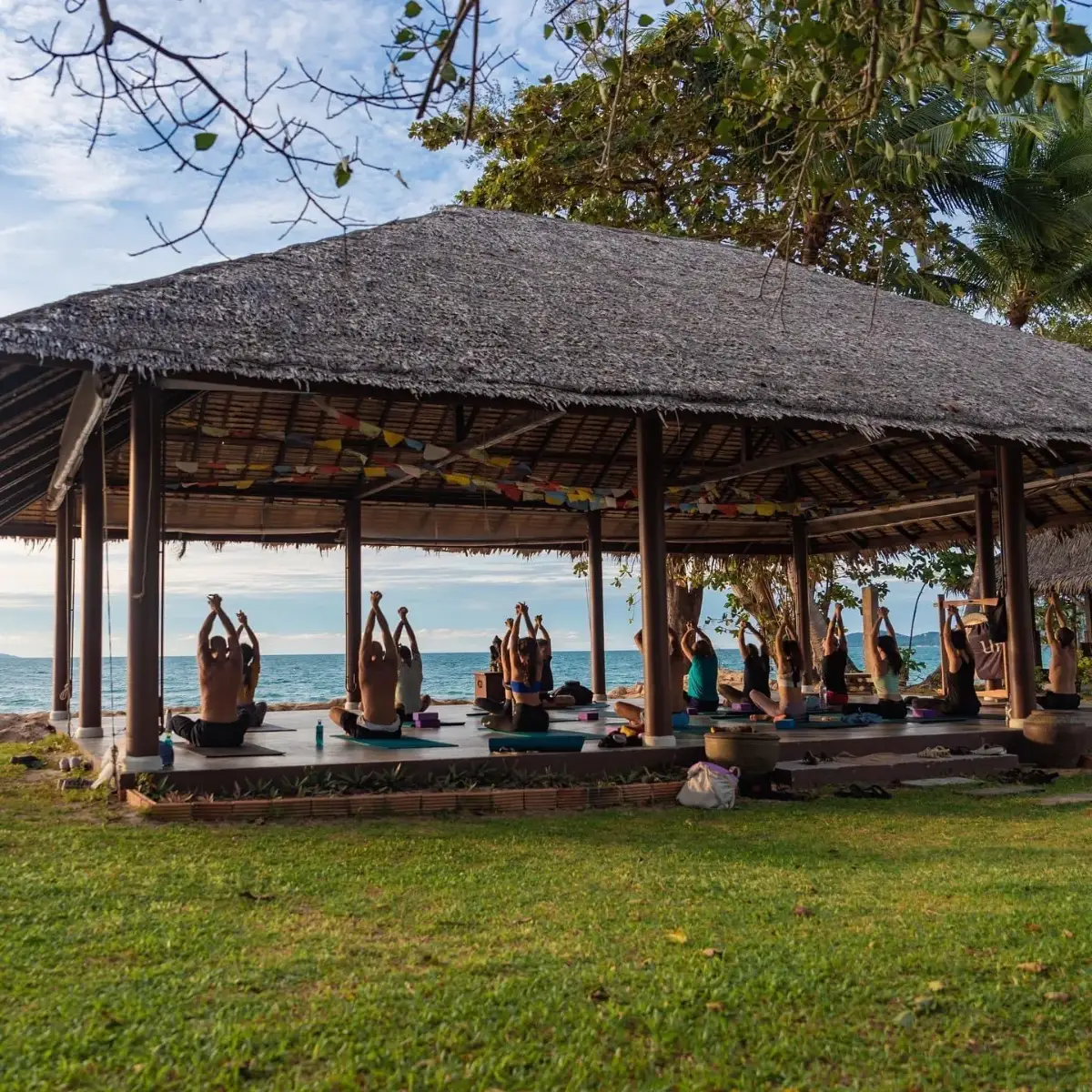
Our Bali course is held at Om Ham Retreat & Resort near Ubud. It is residential: you can live and study at the venue, or take a non-residential place.
For room types, photos of the venue and current dates, see the Bali teacher training at Om Ham Resort. If you need help planning how to get there, ask us before you book flights.
What does the Bali course include, and what does it cost?
It is a 21-day, 200-hour teacher training that ends with a Yoga Alliance certificate. Fees start at €1,700 for the non-residential option, and residential places add a room and two meals a day, Monday to Saturday.
The course covers pranayama, philosophy, anatomy and teaching methodology. The page describes the meals as vegetarian and “sattvic (balanced)”, and there are no meals on Sundays, so plan to eat out that day. If you want to know why a yogic diet is part of the training, read our guide to yogic nutrition and wellness. The course page lists every room option and its fee.
Do I need travel insurance?
We recommend it for any trip abroad. Check that your policy covers a residential yoga course, not just a beach holiday.
In its travel advice for Indonesia, the UK Foreign, Commonwealth & Development Office tells travellers to “get appropriate travel insurance” and says “Insurance should cover your itinerary, planned activities and expenses in an emergency.” That advice is written for UK travellers, but the point holds for everyone: read what your policy covers before you fly.
Is Bali right for me, or should I train somewhere else?
Bali suits you if the dry-season months fit your plans and you want to train inland near Ubud. If you are still choosing, compare it side by side with our other two locations.
We recommend 4–6 months of regular yoga practice before you join our 21-day course. Our comparison of yoga teacher training in Goa, Bali and Thailand puts the three courses in one table. If you are new to yoga and unsure whether three weeks of training is right for you, read is a 21-day yoga teacher training right for a beginner? And if you want time on the island without the study load, a yoga retreat in Bali is a gentler place to start. Our guide to choosing between a yoga retreat and a teacher training can help you decide.
Questions students ask
- When is the dry season in Bali?
- As a general guide, the dry season is broadly April to October and the wet season broadly November to March. The timing varies from year to year, so pack for some rain whenever you go.
- How long can I stay in Bali on an e-VOA?
- Indonesia’s immigration directorate says the e-VOA is valid for 30 days and can be extended once, for a further 30 days, online. Check the current rules on the official immigration sites before you book.
- How much is the Bali tourist levy?
- IDR 150,000 per person, paid once per trip and only by cashless payment, according to the Bali provincial government’s Love Bali FAQ. You can pay online before you travel or at the airport.
- Are meals included on the Bali teacher training?
- Residential places include two meals a day, Monday to Saturday, and there are no meals on Sundays. Non-residential places do not include meals or a room.
- Where is the Bali teacher training held?
- At Om Ham Retreat & Resort near Ubud. The course page has room options, photos and current dates.