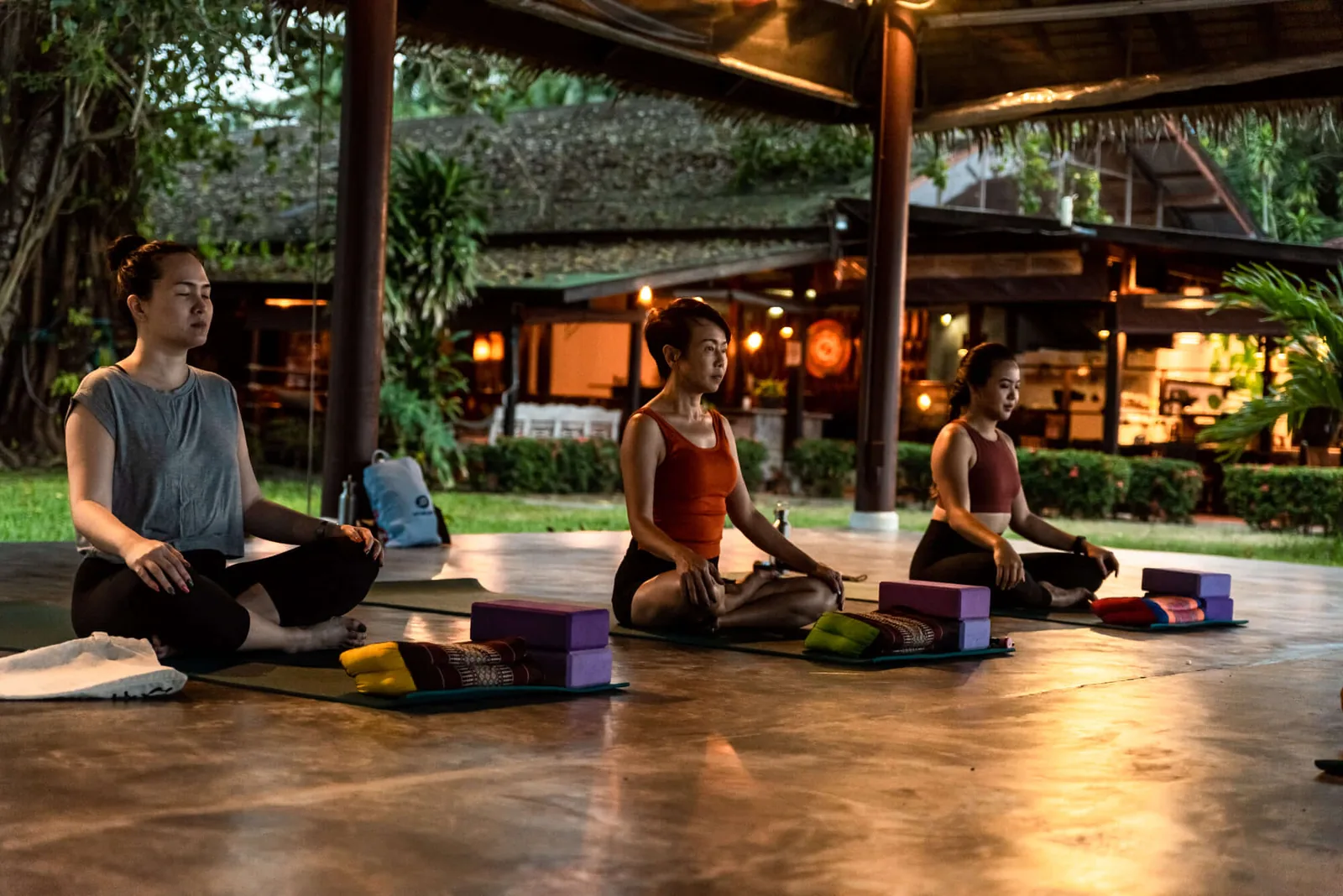
Should I do a yoga retreat or a teacher training first?
Choose a retreat first if you have practised regularly for less than about four months, want rest more than study, or have only a week off. Choose a teacher training now if you have 4–6 months of regular practice, want to learn to teach or study yoga in depth, and can give it 21 full days.
- A retreat is a week of practice, meditation and rest. A teacher training is 200 hours of study in 21 days.
- Our retreat pages list no certificate. Our teacher training gives a Yoga Alliance Certificate of Completion.
- Steady practice is the deciding factor: we recommend 4–6 months of it before a teacher training.
- Time off, budget and how much study you want usually settle the rest. The checklist below walks through all six questions.
Many people who look at a yoga teacher training also look at a retreat, and the other way round. They are different things. A retreat is a week to practise, slow down and rest. A teacher training is three weeks of study with a clear goal: learning to teach. This guide compares the two using our own course pages, then gives you a checklist to decide which to do first. The checklist is our guidance, not a set of rules.
A retreat and a teacher training side by side
We run a 7-day retreat in Goa and a retreat in Koh Samui, Thailand, plus a retreat in Sri Lanka and a retreat in Bali. Our teacher training compared here is the 200-hour yoga teacher training in Goa.
| Aspect | Our yoga retreats | Our 200-hour teacher training in Goa |
|---|---|---|
| Length | Six nights’ accommodation on all four retreat pages; Goa, Thailand and Bali are billed as 7-day retreats | 21 days, with 20 nights’ accommodation on the residential plan |
| A typical day | A sample day that may vary: morning yoga class, rest time, sound healing or group meditation, an art therapy or sharing session, restorative yoga or sunset meditation, night meditation | 200 hours of training fitted into 21 days, so long, full days. Ask us for the current timetable |
| What you study | No syllabus: practice, breath work and meditation, plus outings on some retreats | Hatha and Ashtanga Vinyasa asana, pranayama, yoga philosophy, anatomy and teaching methodology |
| What you leave with | A week of practice and rest | The training to start teaching, and a foundation for your own practice |
| Certificate | None listed on our retreat pages | Yoga Alliance Certificate of Completion |
| Fees listed on our pages | Goa, Thailand and Sri Lanka: from €850 for a standard room, with six nights’ accommodation included. Bali: no fees listed yet | From €1,400 non-residential (no accommodation); from €1,800 with shared accommodation |
| Experience needed | All four retreat pages say all levels are welcome; the Goa, Thailand and Bali pages add “including complete beginners” | We recommend 4–6 months of regular practice |
Lengths, the sample day, the syllabus, the certificate and the fees come from our course pages; check them for current details before you book. The practice recommendation is ours. The retreats differ in their extras: the Goa and Bali pages list group sound healing and a sharing circle, the Thailand page a Thai massage, a temple visit and a waterfall, and the Sri Lanka page surfing, a jungle safari and local temples.
The decision checklist
Answer each question honestly. This is our general guidance, not an entry test, and you will not land in one column for every row.
| Question | Points to a retreat first | Points to a teacher training now |
|---|---|---|
| How long have you practised regularly? | Less than about four months, or on and off | 4–6 months or more, most weeks |
| What do you want from the trip? | Rest, a reset and a week of practice | To learn to teach, or to study yoga in depth |
| How much time can you take off? | About a week | Three full weeks, plus travel days either side |
| What can you spend? | Around a retreat fee, plus flights | A course fee, flights and three weeks away from work |
| How much study do you want? | Little or none: you want to practise and rest | Daily theory (anatomy, philosophy, teaching method) as well as practice |
| How are your body and energy right now? | Tired and wanting a lighter schedule | Well enough for long days of practice |
How to read it. If most of your answers sit in the middle column, do a retreat first. If most sit in the right-hand column, do the teacher training now. If you are split, the first two rows decide it: without steady practice, a retreat is the better first step, and if your goal is to teach, a retreat will not get you there, so plan the training and use the months before it to practise.
When a retreat first makes sense
A retreat suits you if you want a week of daily practice without a syllabus to work through. It is also a gentle way to find out how your body handles practising every day, which is useful to know before 21 days of it.
If you are curious about our teacher training, the 7-day retreat in Goa is a good test. According to the retreat page, it runs at the same Mandrem centre where our 200-hour teacher trainings take place and is led by the same faculty. A week there shows you the shala, the setting and the way we teach before you commit to three weeks.
If you mainly want a break, pick the place and extras that appeal: the beach in Goa or on Koh Samui, surfing and temples in Sri Lanka, or rice fields in Bali. If you want to unwind after a demanding time, that is a good reason to go, but we cannot promise any particular effect on stress or health, and a retreat is not a substitute for medical care.
When a teacher training now makes sense
A teacher training suits you if you already practise regularly, want to understand yoga beyond the poses, and can step away from work for three weeks. You do not need to plan to teach: some people take a training purely to deepen their own practice. But you should want to study. Anatomy, philosophy and teaching methodology are part of the 200 hours, not optional extras.
If you are close but not sure you are ready, our post on whether a 21-day yoga teacher training is right for a beginner goes deeper into readiness, and our guide on how to prepare for a yoga teacher training covers the months before.
A teacher training is also where a teaching credential starts. Yoga Nisarga is registered with Yoga Alliance, and our course gives you a Yoga Alliance Certificate of Completion. Beyond that, Yoga Alliance’s “Membership Reimagined” page describes “a clear pathway from yoga teacher training graduate to credentialed teacher”, and says that “in 2027, Yoga Alliance will take credentials to the next level”, and that the credential involves “completing and passing an assessment”. Our retreats lead to neither.
Doing both: a retreat, then a teacher training
You do not have to choose forever. The plan we would suggest if you are short of practice is a retreat now, regular practice at home for the next few months, then a teacher training once you reach 4–6 months of steady practice. The retreat gives your practice a push, and the training builds on it.
In our view the order rarely works the other way, because a teacher training already includes a great deal of practice. If you finish a training and want time to let it settle, a retreat afterwards is a good way to keep practising without the study load. Our post on lifestyle changes after a yoga teacher training covers what that period can look like.
Our teacher training in Goa
Our 200-hour course runs for 21 days near Mandrem beach in North Goa, covers Hatha and Ashtanga Vinyasa and is Yoga Alliance certified (RYS 200). If the checklist pointed you to a teacher training, see the course page for current dates and fees. If it pointed you to a retreat, the four retreat pages above have the details. Either way, you can ask us which suits you before you book.
Questions students ask
- Should I do a yoga retreat before a teacher training?
- If you have practised regularly for less than about four months, yes. A retreat gives you a week of daily practice without the study load. If you already have 4–6 months of regular practice and want to learn to teach, you can go straight to a teacher training.
- Do I get a certificate from a yoga retreat?
- Our retreat pages list no certificate. Our 200-hour teacher training in Goa gives a Yoga Alliance Certificate of Completion. Yoga Alliance describes a pathway from training graduate to credentialed teacher, with an assessment, and says credentials step up in 2027.
- Can a complete beginner join a yoga retreat?
- Yes. Our Goa, Thailand and Bali retreat pages say the retreat is open to all levels, including complete beginners, and the Sri Lanka page says all levels are welcome. For a teacher training, we recommend 4–6 months of regular practice first.
- How long is a yoga retreat compared with a teacher training?
- Our retreats include six nights’ accommodation, and the Goa, Thailand and Bali retreats are billed as 7-day retreats. Our 200-hour teacher training in Goa lasts 21 days.
- Is a yoga retreat good for stress?
- A retreat can be a good way to rest after a demanding time, but we make no health promises, and a retreat is not a substitute for medical care. If you have a medical condition, talk to your doctor before you book a retreat or a training.